Well, the definitions say circumcision doesn't count. A vaccine is something that stimulates the immune system against the disease in question. Unless circumcision exposes the man to HIV antigens? I'm thinking not.
But what is the point of a vaccine? In epidemiologic terms, it is to a) prevent infection, b) prevent or decrease transmission, or c) prevent or decrease symptoms of the disease. So does circumcision count? I'm not sure.
Yes, we have good evidence that circumcised men are less likely to become infected. The bias involved, however, is overwhelming -- the differences in most of these studies that led to one man being circumcised rather than another stem from culture and religion. Could either of those factors affect, say, sexual behavior? Probably. Do we have a plausible biological reason for HIV preferring uncircumcised men? Not really, in my opinion, although there's a lot of hot air on the subject. We have a link. That's all we can really say.
So what do we do with a link, with a cultural action that may be protective? In my opinion, ignore it and push cultural acceptance of condoms and abstinence. We know they work and we know why. Until a real vaccine comes along.
Monday, January 15, 2007


Sunday, January 14, 2007
Book Review: The American Plague
Fantastic first part, describing how the Memphis yellow fever epidemic of 1878 could have happened. Background, flashbacks, gripping heat-of-the-moment storytelling: it really makes you feel what it must have been like to be there. Strangely enough, all the reviews on the back refer to that section . . .
The rest of the book, outlining the contribution of many, including Walter Reed, to understanding the way yellow fever worked and how to stop it, was good. Not spectacular, but good. Some of the human drama, the stories behind the human subjects in the Havana trials, are really quite stirring. For the most part, though, it's just solid storytelling. It's almost, at times, as if the author got a little bored, herself, and couldn't really be bothered to keep the energy up. With the lessons that could be taught about the spread of yellow fever in modern Texas, I don't know why the end wasn't a bit more . . harrowing? . . frightening? . . interesting?
You should read this book for the story of what happened to Memphis. The rest is good background in the subsequent history of yellow fever, but the book is worth it mostly for the first section.
The rest of the book, outlining the contribution of many, including Walter Reed, to understanding the way yellow fever worked and how to stop it, was good. Not spectacular, but good. Some of the human drama, the stories behind the human subjects in the Havana trials, are really quite stirring. For the most part, though, it's just solid storytelling. It's almost, at times, as if the author got a little bored, herself, and couldn't really be bothered to keep the energy up. With the lessons that could be taught about the spread of yellow fever in modern Texas, I don't know why the end wasn't a bit more . . harrowing? . . frightening? . . interesting?
You should read this book for the story of what happened to Memphis. The rest is good background in the subsequent history of yellow fever, but the book is worth it mostly for the first section.
Just to brag
I want to brag: I have the cutest nephew/godson in the world.

Yes, isn't he adorable? And he likes to pose:
Which, given that I have a new camera and had it with me on my last visit, is very convenient.
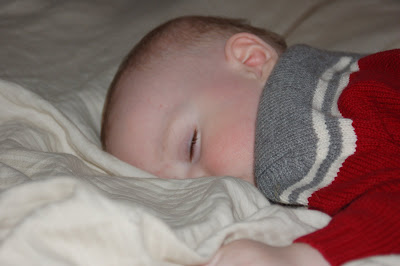 Would you believe I took that picture in a completely unlit room? I'll have lots of fun pictures to post when I get back from Uganda.
Oh, and since I did take other pictures, here's a glimpse of WNY in December:


Isn't that depressingly non-white? Oh well, it's snowing here today!

Yes, isn't he adorable? And he likes to pose:

Which, given that I have a new camera and had it with me on my last visit, is very convenient.
 Would you believe I took that picture in a completely unlit room? I'll have lots of fun pictures to post when I get back from Uganda.
Oh, and since I did take other pictures, here's a glimpse of WNY in December:


Isn't that depressingly non-white? Oh well, it's snowing here today!
Cruelty?
I don't debate the premise of this article, that vegan clothing is animal cruelty-free. I would wonder if it is human cruelty-free (are all the links on the chain paid living wages?).
No, my problem is more with the idea that non-vegan clothing/food is cruel. It can be, of course. But it doesn't have to be -- and I don't like the implication that it does.
No, my problem is more with the idea that non-vegan clothing/food is cruel. It can be, of course. But it doesn't have to be -- and I don't like the implication that it does.
Tuesday, January 09, 2007
Bias?!?! No!
Yes, that's right: nutrition studies funded by animal food companies are biased.
I'll wait for the shock to die down.
We all know (or we should) that companies funding research into their product will sit on any negative results. Thus, there's a simple publication bias towards positive results (which is there for any study, really, but more so when the funding is private and financially interested). Be aware. Any article will (or, again, should) mention the source of funding. Look at it and understand what it might mean to the results.
I'll wait for the shock to die down.
We all know (or we should) that companies funding research into their product will sit on any negative results. Thus, there's a simple publication bias towards positive results (which is there for any study, really, but more so when the funding is private and financially interested). Be aware. Any article will (or, again, should) mention the source of funding. Look at it and understand what it might mean to the results.
Friday, January 05, 2007
So far, so good
Yes, we have a new director at the WHO. A woman, a Chinese woman! And, of course, one of her first priorities is women.
Why? Because women do the best, in most situations, at getting health care to children who need it. Because educating a woman on nutrition affects her entire family. Because women are teachers and nurses and farmers. Good for Dr. Chan!
Second priority is Africa: it's hip, it's got lots of important diseases, and it has the biggest opportunity to show improvement. Of course, it also has the biggest opportunity to fail completely. Good luck, God speed.
At the end of her priorities is bird flu. Why? Because it's not as important as a lot of other things that are going on. But it's the controversy over Dr. Chan; she's Chinese, from the government that hid its bird flu problem (badly). Is she going to favor her non-transparent home government? We'll have to wait and see.
Now, though, she just needs to start the job. Alright, time to show your stuff. Get to work.
Why? Because women do the best, in most situations, at getting health care to children who need it. Because educating a woman on nutrition affects her entire family. Because women are teachers and nurses and farmers. Good for Dr. Chan!
Second priority is Africa: it's hip, it's got lots of important diseases, and it has the biggest opportunity to show improvement. Of course, it also has the biggest opportunity to fail completely. Good luck, God speed.
At the end of her priorities is bird flu. Why? Because it's not as important as a lot of other things that are going on. But it's the controversy over Dr. Chan; she's Chinese, from the government that hid its bird flu problem (badly). Is she going to favor her non-transparent home government? We'll have to wait and see.
Now, though, she just needs to start the job. Alright, time to show your stuff. Get to work.
Turns out they're not actually a good idea!
Story posted today:
Sad, but true.
Study: Antibiotic use in poultry hurts bottom lineYes, one of the best uses of epidemiology -- figuring out that something we don't want to happen isn't a good idea economically. Listen, people: use economics to back up your moral views. Otherwise, people just won't listen.
By Alicia Karapetian on 1/4/2007 for Meatingplace.com
A new study conducted by researchers at Johns Hopkins University contends that using antibiotics in poultry for growth-promoting purposes actually reduces the net value of each broiler carcass.
According to the study's results, growth-promoting antibiotics decrease the value of each carcass by almost one cent.
The research, which appears in this month's issue of the journal Public Health Reports, claims to be the first economic analysis of the practice in poultry production. The Johns Hopkins researchers used data previously published by Perdue Farms, which looked at 7 million broilers produced by the No. 4 processor.
However, a National Chicken Council spokesman told Meatingplace that the study's results lacked significance because industry use of growth-promoting antibiotics has declined in recent years, and the primary use of antibiotics is for animal health.
Jay Graham, one of the authors of the study, told Meatingplace that his research showed that the companies that do not use growth-promoting antibiotics only represent 38 percent of American poultry production. Graham also highlighted international implications of the study. "This [study] is important because poultry production is growing rapidly [overseas], mostly in developing countries," he said. "There is a belief that using [growth-promoting antibiotics] in feed is necessary from an economic perspective."
Organizations such as Keeping Antibiotics Working oppose the use of antibiotics in animal feed due to fears of potential human resistance to drugs deriving from the same substances. NCC maintains there are no proven cases of human health problems resulting from antibiotic use in the U.S. poultry industry.
Graham, however, contends that antibiotic use in animal feed does affect drug resistance levels in humans. "There are studies that indicate some human drug resistant infections most likely originate from agricultural use of antibiotics," he said.
Sad, but true.
Wednesday, December 20, 2006
Book Review: The White Man's Burden
If you are interested in development in any way (including in an armchair fashion), you must read this book. Snarky fun mixed with depressing stats to give an accurate and overall negative view of the traditional development industry.
Especially good is the chapter "Invading the Poor". Most of the foreign aid in the US is military; Easterly shows that such military aid is useless to harmful. Also good are the 'snapshots' beginning each chapter, showing real life issues -- anecdotal, but they put things in perspective.
The book is summed up in a paragraph close to the end:
Especially good is the chapter "Invading the Poor". Most of the foreign aid in the US is military; Easterly shows that such military aid is useless to harmful. Also good are the 'snapshots' beginning each chapter, showing real life issues -- anecdotal, but they put things in perspective.
The book is summed up in a paragraph close to the end:
Aid won't make poverty history, which Western aid efforts cannot possibly do. Only the self-reliant efforts of poor people and poor societies themselves can end poverty, borrowing ideas and institutions from the West when it suits them to do so. But aid that concentrates on feasible tasks will alleviate the sufferings of many desparate people in the meantime. Isn't that enough?It's enough for me.
Tuesday, December 19, 2006
Once again
Yes, we know -- women in the sciences have to be twice as good to do the same job. They have to worry about things men don't.
Read it. I don't have much to add.
Read it. I don't have much to add.
Who are these people?
Why are we talking about small farmers resisting the national animal ID system (NAIDS)? How about because the majority of cow-calf farms (80%) in the US have fewer than 50 animals? Because more than half of those farms don't use any form of individual animal identification? Because those animals travel hundreds of miles and mix with animals from a wide area before slaughter? Because those are your hamburgers and steaks?
Why are we talking to hobby farmers? Because we (and by 'we' I mean the NYT) are a city paper with no connection to the livestock industry.
NAIDS is in no way an invasion of privacy. If you are selling animals for public consumption, you cannot claim that identifying them as having come from you is invading your privacy. If that was true, factories would never be responsible for replacing faulty products and the recall would disappear. I know you don't want to think that your animal might start a pandemic, but it could!!! No matter how safe your farm management is. No matter how libertarian your views are. NAIDS is a public safety measure. Accept it.
Why are we talking to hobby farmers? Because we (and by 'we' I mean the NYT) are a city paper with no connection to the livestock industry.
NAIDS is in no way an invasion of privacy. If you are selling animals for public consumption, you cannot claim that identifying them as having come from you is invading your privacy. If that was true, factories would never be responsible for replacing faulty products and the recall would disappear. I know you don't want to think that your animal might start a pandemic, but it could!!! No matter how safe your farm management is. No matter how libertarian your views are. NAIDS is a public safety measure. Accept it.
And then the editorials!
In the same vein as the last post, but a bit sideways: people seem to think the process of protecting their food supply doesn't move quickly enough. This editorial suggests that more funding will speed up the investigations into deadly outbreaks.
While I'm never going to be against more funding for my field (that would be like asking to not be given a raise), I don't think that's the answer. In fact, I dare say there is no answer. Do you think the FDA is reckless with your food safety? Do you believe in the 5 second rule? Do you eat at notoriously unsafe fast food restaurants? Do you eat bagged spinach without washing it? Do you blame the FDA for that.
Of course you do. We don't believe in personal responsibility anymore, only corporate faults and legislation to punish them.
As to the issue of speed . . . we're limited, but it's not usually by funds. We're limited by the speed (or lack thereof) of the diagnosing physicians, laboratories, and state health departments. We're limited by the helpfulness (or lack thereof) of the people involved in the outbreak in answering questionnaires. We're limited by political wrangling in the main offices, deciding the economic cost/benefit ratio of the possible moves. We're limited by the fact that there are a lot of people out there eating a lot of food.
Lesson to take home (this may sound familiar if you've been reading a while): you're responsible in large part for your own food safety. We can do our best to keep your food free of pathogens and pollutants, but you're going to have to accept some of the onus of food safety.
While I'm never going to be against more funding for my field (that would be like asking to not be given a raise), I don't think that's the answer. In fact, I dare say there is no answer. Do you think the FDA is reckless with your food safety? Do you believe in the 5 second rule? Do you eat at notoriously unsafe fast food restaurants? Do you eat bagged spinach without washing it? Do you blame the FDA for that.
Of course you do. We don't believe in personal responsibility anymore, only corporate faults and legislation to punish them.
As to the issue of speed . . . we're limited, but it's not usually by funds. We're limited by the speed (or lack thereof) of the diagnosing physicians, laboratories, and state health departments. We're limited by the helpfulness (or lack thereof) of the people involved in the outbreak in answering questionnaires. We're limited by political wrangling in the main offices, deciding the economic cost/benefit ratio of the possible moves. We're limited by the fact that there are a lot of people out there eating a lot of food.
Lesson to take home (this may sound familiar if you've been reading a while): you're responsible in large part for your own food safety. We can do our best to keep your food free of pathogens and pollutants, but you're going to have to accept some of the onus of food safety.
Shoeleather Epidemiology
You cannot do epidemiology in a bubble. Or (entirely) in a lab. It is applied or it is nothing.
When the NYT lauds the detective work of the epidemiologists who traced down the Taco Bell E coli outbreak, are they praising the field or misunderstanding it? Yes, it was necessary to ask around to find the link between these cases. Yes it was well done. But how else were they supposed to do it? I can't see that the researchers did anything remarkable in this case. They followed the time-honored tradition of John Snow (review of The Ghost Map to come when I finish reading it). They weren't breaking ground.
And yet. They did a good job. They found the culprit. They got it shut down. Good for them. They deserve an article in their praise. Maybe such articles will lead more people to understand what it is we do!
When the NYT lauds the detective work of the epidemiologists who traced down the Taco Bell E coli outbreak, are they praising the field or misunderstanding it? Yes, it was necessary to ask around to find the link between these cases. Yes it was well done. But how else were they supposed to do it? I can't see that the researchers did anything remarkable in this case. They followed the time-honored tradition of John Snow (review of The Ghost Map to come when I finish reading it). They weren't breaking ground.
And yet. They did a good job. They found the culprit. They got it shut down. Good for them. They deserve an article in their praise. Maybe such articles will lead more people to understand what it is we do!
After a long pause
Fueled by sugar/chocolate/cocktail wieners from the Dean's Office Holiday Party, I return to write all those posts I've been meaning to. The last week and a half have reminded me why research never appealed to me before I learned about epi -- who wants to spend 5 hours a day with a micropipetter? Give me a laptop any day . . .
Monday, November 27, 2006
And now for something completely better
Isn't it wonderful? Public health money doing its job; I saw this at the gym this morning and had to share. Watch the video -- it's worth it!
Never underestimate the power of bureaucracy
Yes, we need to worry about bioterrorism threats (or, if not we, the CDC does). What's the best bioterrorism threat we've given ourselves? Decrease funding for basic disease control! Make public health political! Hire more administrators than scientists to run our disease labs! Sometimes I despair of these people.
Friday, November 17, 2006
Hunger vs. Food security
From meatingplace.com (members-only):
| USDA: You're not hungry, you just have very low food security |
| by Pete Hisey on 11/17/2006 for Meatingplace.com |
| According to USDA's newly published report, "Household Food Security in the United States, 2005," hunger in the United States has declined slightly since 2004. According to the report, about 11 percent of the U.S. population is classified as "food insecure," with about one-third of those classified as having "very low food security." That means that members of these 3.9 million households and 35 million people experience varying levels of hunger during the year, ranging from skipping meals or eating smaller portions to losing weight due to lack of food. The number of households experiencing hunger remains unchanged from 2004, but overall the number of Americans with "very low food security" has risen over the past five years. However, the word hunger does not appear in the report, which Democrats charge was held back until after the mid-term elections, a charge called "ridiculous" by USDA. Instead, hungry people are described as suffering from "disruptions in eating patterns and food intake." Mark Nord, the USDA sociologist responsible for the report along with co-authors Margaret Andrews and Steven Carlson, defends dropping the terms hunger and hungry to describe the phenomenon of not having enough food by saying the terms are not scientific. "We don't have a measure of that condition," he said. Consumer and poverty groups are up in arms about the abrupt change in terminology, but USDA says that the change was part of an overhaul of the entire report process to ensure that language used in the report is "conceptually and operationally sound." Three years ago, USDA asked for recommendations from the Committee on National Statistics of the National Academies to suggest more scientifically rigid terminology. The committee, among other suggestions, recommended that the word hunger be dropped, since it could describe anything from a mildly uncomfortable feeling familiar to everyone prior to mealtime to "discomfort, illness, weakness or pain." "Hunger is clearly an important issue," said Nord, but since there is no consensus about what exactly it refers to, it's not particularly meaningful as it relates to the economic research that backs the report. |
Tuesday, November 14, 2006
How does this apply to your life . . .
. . . or how doesn't it?
People really have trouble with math instruction. They think that there is no in-between, that it must be rote memorization or free-form. Really, whose idea was this -- students don't learn long division because it stifles creativity?!?! We don't insist on allowing creativity with grammar. We don't allow creativity with basic rules. We don't creatively mix chemicals in our school labs (research labs are another story, of course). Why does division have to be creative?
The result is people who are either afraid of math or don't understand it. If you don't think that's a problem, think about how many people have a hand in giving you medicine in the hospital: the doctor writes the Rx, the pharmacy fills it, and the nurse gives it, all using math along the way.
See, I presented my research to a room full of clinicians, interns, and residents today. The talk relied heavily on understanding probability, so I did a fairly thorough review. I didn't get into the math involved on the disease model, though, and I assumed more statistical knowledge than most of them probably had. After, a surgeon thanked me, but said I should have covered the math more. I told him I didn't want to go over the heads of the interns and residents. His response: well, they need to learn it sometime. One of my epi-leaning colleagues joked that it is now my job to teach them. Sorry for the coming rant, but really! I have 25 minutes to present my research; do I need to spend half of it teaching basic statistics to my peers?
The truth, of course, is that epidemiologists do become the de facto sources of statistical knowledge in veterinary medicine. Rather than study it themselves, other vets hand us the math. We do our own research, but we also have to analyze other people's data. How does this relate to math teaching? Most of them were convinced early on that 1) they weren't good at math and 2) they wouldn't need to be.
And the exceptions (like my colleagues and me) get to pick up the pieces.
People really have trouble with math instruction. They think that there is no in-between, that it must be rote memorization or free-form. Really, whose idea was this -- students don't learn long division because it stifles creativity?!?! We don't insist on allowing creativity with grammar. We don't allow creativity with basic rules. We don't creatively mix chemicals in our school labs (research labs are another story, of course). Why does division have to be creative?
The result is people who are either afraid of math or don't understand it. If you don't think that's a problem, think about how many people have a hand in giving you medicine in the hospital: the doctor writes the Rx, the pharmacy fills it, and the nurse gives it, all using math along the way.
See, I presented my research to a room full of clinicians, interns, and residents today. The talk relied heavily on understanding probability, so I did a fairly thorough review. I didn't get into the math involved on the disease model, though, and I assumed more statistical knowledge than most of them probably had. After, a surgeon thanked me, but said I should have covered the math more. I told him I didn't want to go over the heads of the interns and residents. His response: well, they need to learn it sometime. One of my epi-leaning colleagues joked that it is now my job to teach them. Sorry for the coming rant, but really! I have 25 minutes to present my research; do I need to spend half of it teaching basic statistics to my peers?
The truth, of course, is that epidemiologists do become the de facto sources of statistical knowledge in veterinary medicine. Rather than study it themselves, other vets hand us the math. We do our own research, but we also have to analyze other people's data. How does this relate to math teaching? Most of them were convinced early on that 1) they weren't good at math and 2) they wouldn't need to be.
And the exceptions (like my colleagues and me) get to pick up the pieces.
Friday, November 10, 2006
Is hot air measured in square feet our hours?
I went to a talk yesterday by Donald Rumsfield.
Well, mostly by him. First we had to sit through a rambling introduction by General Myers. That man can blather with the best of them.
The amazing thing was that, after an hour of talking, nothing was said. Not nothing important; nothing. Ah, politics.
Some phrases/concepts that might be interesting to those without access to such things:
Well, mostly by him. First we had to sit through a rambling introduction by General Myers. That man can blather with the best of them.
The amazing thing was that, after an hour of talking, nothing was said. Not nothing important; nothing. Ah, politics.
Some phrases/concepts that might be interesting to those without access to such things:
- communists are totalitarian, just like non-centralized terrorists
- "The enemy has brains. They do things."
- We are fighting a war against people with no home state to defend; this is why we invaded 2 countries
- we should study history to avoid repeating mistakes
Stool essentials
Yes, I know, bad pun.
Really, sanitation is essential. We pay so much attention in this country to manure management in our CAFO's, but we ignore the fact that much of the world doesn't have toilets. Including, and this is important, the source of much of our fresh supermarket produce. It is important, even if you're not a bleeding-heart.
Really, sanitation is essential. We pay so much attention in this country to manure management in our CAFO's, but we ignore the fact that much of the world doesn't have toilets. Including, and this is important, the source of much of our fresh supermarket produce. It is important, even if you're not a bleeding-heart.
Monday, November 06, 2006
Oversaturated?
Are we getting too obsessed by killing germs? Read this and tell me what you think. By asking the question, I guess I've told you my answer . . .
Subscribe to:
Posts (Atom)